العربية
 Español
 Pусский
 lingua italiana
 Français
 Deutsch
 Portugues



Specify airport apron LED floodlighting with the right maintained illuminance, uniformity, glare control, photometric evidence, resilience, and supplier documentation.
Airport apron LED floodlighting should be specified as a complete visual system, not as a wattage purchase. The design must help pilots, ground crews, drivers, and security teams work around aircraft without glare, deep shadows, or confusing spill light. That means the tender must define maintained horizontal and vertical illuminance, uniformity, aiming, obstruction limits, power recovery, controls, and verification documents before a fixture is approved.
For B2B buyers, the practical lesson is simple: start with the operating task and the governing aviation authority, then use photometric calculations to prove the layout. A high lumen figure can support the design, but it cannot replace a compliant calculation or an on-site acceptance test.
Why Airport Apron Lighting Is Different
An apron combines several demanding visual tasks. Aircraft park and manoeuvre close to people, service vehicles, fuel equipment, baggage systems, and fixed infrastructure. Crews must read markings, judge clearances, inspect surfaces, and recognize colours. Pilots and air traffic controllers must not be distracted by direct or reflected light.
FAA airport design guidance recommends aiming apron luminaires downward, using baffles or shields to prevent uplight, creating uniform illumination with overlapping light sources, and coordinating the design with airport operations and other stakeholders. It also states that apron lighting must not exceed applicable obstruction standards [1]. These requirements make beam control, mounting position, and stakeholder review as important as luminaire output.
Which Lighting Values Should a Buyer Put in the Tender?
There is no single lux value that should be copied into every international airport tender. The project must follow the local aviation regulator, airport standards, the aircraft category, and the intended apron tasks. However, published regulations are useful for understanding how performance requirements are structured.
For example, Australia’s Manual of Standards Part 139 requires 20 lux maintained average horizontal illuminance at a parking position for larger aeroplanes, plus 20 lux vertical illuminance at a height of 2 m in the relevant parking direction. The average-to-minimum uniformity ratio must not exceed 4:1. For apron areas used only by smaller aeroplanes, the comparable value is 5 lux. Other areas have separate requirements, including graded illumination at apron extremities [2]. These are Australian requirements and a specification example, not a substitute for the rules in another jurisdiction.
Table 1 Evidence Based Apron Lighting Tender Matrix
| Requirement | Evidence to request | Procurement decision |
|---|---|---|
| Maintained illuminance | Horizontal and vertical calculation grids; maintenance factor; local standard | Reject initial-only values or unreferenced lux claims |
| Uniformity and shadows | Average, minimum, ratio, aircraft envelope, overlapping-source layout | Check the whole stand, not only points under poles |
| Glare and uplight | Aiming schedule, shields, observer viewpoints, spill-light review | Require redesign if pilot or tower sightlines are affected |
| Colour and flicker | CRI/spectral data, driver flicker data, phase and electrical design | Confirm marking recognition and rotating-equipment safety |
| Resilience and controls | Secondary power logic, restart time, dimming defaults, fault reporting | Match airport operating and emergency procedures |
| Durability and service | IP/IK evidence, corrosion and temperature data, access and spares plan | Evaluate lifecycle risk, not only purchase price |
Source: Australia CASA Part 139, Section 9.16 [2]. Values are a jurisdiction-specific example; local aviation requirements govern.
Do Not Buy Airport Floodlights by Wattage Alone
Wattage describes electrical input, not the light delivered to the work plane. Even lumens do not show whether the installation will achieve the required vertical light, uniformity, glare control, and shadow reduction. Two products with similar wattage can produce very different results because their optics, aiming precision, lumen maintenance, and mounting geometry differ.
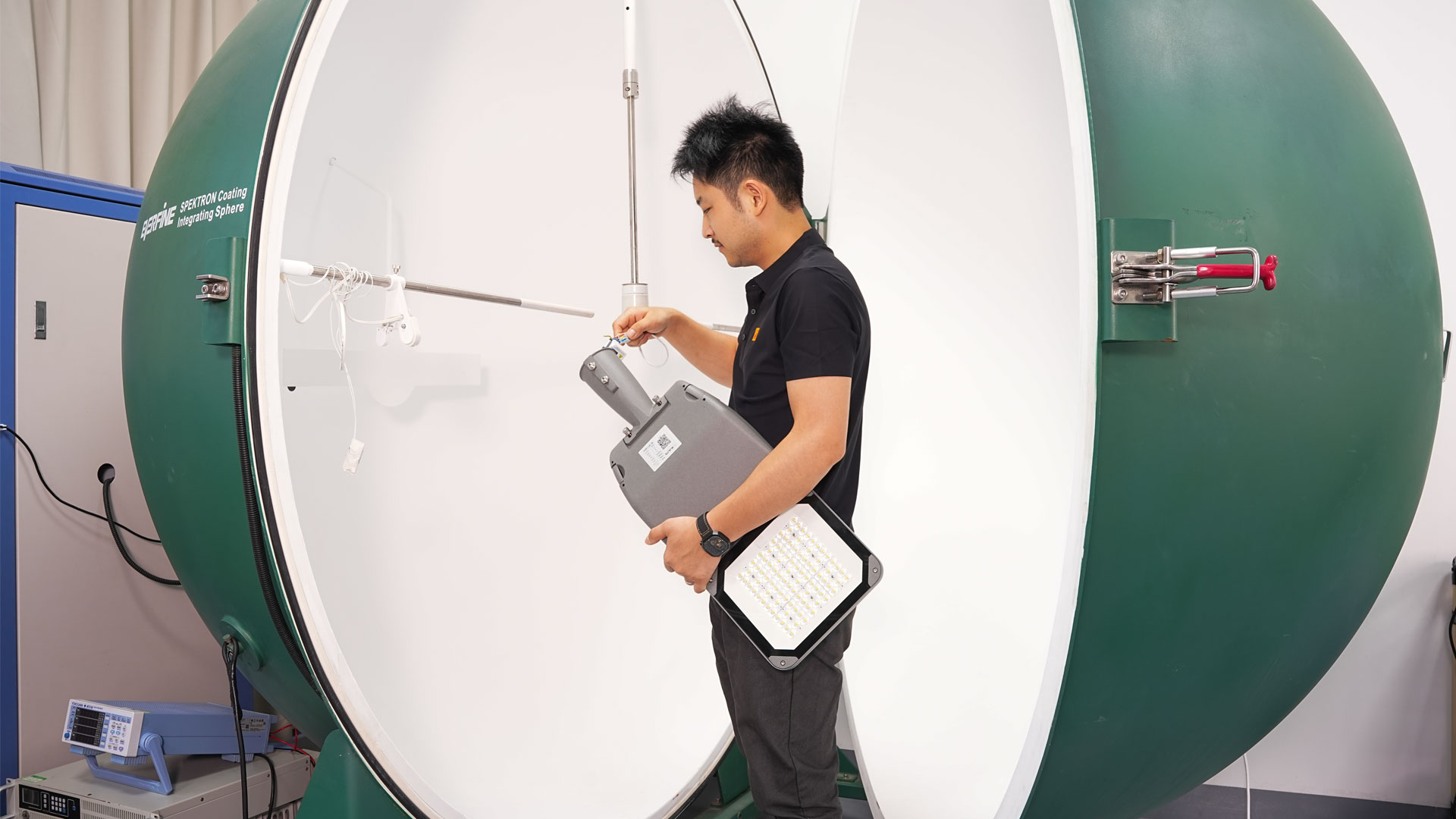
A defensible submittal should therefore include IES or LDT photometric files, a calculation grid for each operational zone, horizontal and vertical results, uniformity, observer positions for glare review, aiming schedules, and a maintenance factor. The calculation should also show the largest aircraft envelope expected at each stand. Where existing poles are reused, the engineer should verify structural capacity, wind exposure, bracket geometry, cable loading, and access for maintenance.
Use Layered Optics to Reduce Shadows and Spill Light
One broad beam from one direction may create bright pavement while leaving service-side shadows around an aircraft. CASA guidance calls for aircraft parking positions to receive light from two or more directions where practicable, specifically to minimize shadows [2]. The FAA likewise recommends overlapping sources for uniform coverage [1].
A practical design may combine medium or wide distributions for general stand coverage with narrower, carefully aimed distributions for distant task zones. The exact mix must come from photometric modelling. More fixtures are not automatically better: poor aiming can increase glare, uplight, energy use, and visual clutter. Shields, asymmetric distributions, accurate brackets, and commissioning measurements should be treated as system components rather than optional accessories.
Check Flicker, Colour Recognition, and Power Recovery
Airport projects also need electrical and operational evidence. Australia’s rules require the spectral distribution to allow aircraft, surface, and obstacle colours to be identified correctly. They also address the risk of a rotating propeller appearing stationary by distributing apron floodlighting across phases of a three-phase supply at major aerodromes [2]. A buyer should request driver flicker data and confirm the electrical design with the airport engineer rather than relying on a generic “flicker-free” claim.
Power interruption behaviour belongs in the tender as well. For larger-aircraft aprons, the same Australian rules require secondary power and defined recovery performance after an interruption; auxiliary lighting may be needed when the main system cannot recover quickly enough [2]. Local requirements may differ, but every project should define emergency supply, restart behaviour, control defaults, and failure reporting before procurement.
Conclusion
Airport apron LED floodlighting is a performance specification, not a catalogue shortcut. The safest procurement path is to define the local requirements, model the complete layout, control glare and shadows, verify electrical resilience, and demand traceable submittal evidence. Alite can support the product-selection and documentation stage, while the airport’s qualified designer and authority retain responsibility for final compliance and acceptance.
References
- Federal Aviation Administration. AC 150/5300-13B, Airport Design, Change 1 with errata. Section 5.14, Apron Area Lighting. //www.faa.gov/documentLibrary/media/Advisory_Circular/AC-150-5300-13B-Airport-Design-Chg1-w-errata.pdf
- Australian Government, Civil Aviation Safety Authority. Manual of Standards Part 139—Aerodromes, Section 9.16, Apron Floodlighting. //www.legislation.gov.au/F2006B00762/2020-03-26/2020-03-26/text/original/epub/OEBPS/document_2/document_2.html
- Alite Lighting. AFL06 LED Flood Light, published product specifications. //www.alitecn.com/flood-light-reflector-50-400w.html
- Alite Lighting. About Alite: outdoor and industrial lighting company profile and project support. //www.alitecn.com/about-us.html