العربية
 Español
 Pусский
 lingua italiana
 Français
 Deutsch
 Portugues



Explore Alite ASL23 LED street lights with up to 200 lm/W, IP66 and IK10 ratings, roadway optics, and tool-free driver access for road lighting projects.
ASL23 LED Street Light: Efficient, Serviceable Lighting for Road Projects
Choosing an LED street light involves more than comparing wattage and purchase price. A successful road lighting project needs the right light distribution, suitable outdoor protection, and a practical way to maintain equipment mounted above the road.
The Alite ASL23 series brings these requirements together with catalog-rated efficacy of up to 200 lm/W, IP66 and IK10 ratings, a die-cast aluminium housing, and tool-free access to the driver compartment.
Specifications shown are brochure values. Confirm performance, options, and supporting documentation for the selected configuration.
Designed Around Practical Road Lighting Requirements
For contractors, lighting designers, and project buyers, a luminaire's value depends on how well it fits the installation. Energy performance matters, but so do optical selection, mounting flexibility, component access, and control compatibility.
The ASL23 LED street light combines these considerations in a product series intended for project-based specification. Its appeal is not one parameter alone, but the combination of features that can help match the luminaire to a particular road or outdoor site.
ASL23 LED Street Light: Key Features at a Glance
The following features are taken from the ASL23 product brochure. Final project requirements should be checked against the selected model and its supporting documentation.
| Feature | Brochure Specification | Project Relevance |
|---|---|---|
| Luminous efficacy | Up to 200 lm/W | Supports energy-conscious luminaire selection. Actual efficacy depends on configuration. |
| Ingress protection | IP66 | Dust-tight enclosure with protection against powerful water jets under specified test conditions. |
| Impact protection | IK10 | Enclosure impact rating corresponding to 20-joule test energy. |
| Housing | Die-cast aluminium with anti-corrosion powder coating | Outdoor construction; coating suitability should match the site's environmental exposure. |
| Maintenance access | Tool-free driver compartment | Simplifies access during inspection and component servicing. |
| Optical options | Type I, Type II and Type III listed | Provides distribution choices for different road and site geometries. |
| Mounting adjustment | −15° to +10°, in 5° increments | Allows installation adjustment to match the approved lighting layout. |
| Control options | Photocell, Zhaga socket and NEMA socket shown | Configuration and driver/controller compatibility must be confirmed. |
| Electrical compartment | Enlarged compartment | Provides space for compatible electrical accessories. |
High Efficacy Matters—But Useful Road Illumination Matters More
The ASL23 brochure lists luminous efficacy of up to 200 lm/W. Luminous efficacy describes how much light a luminaire produces per watt of electrical input, making it an important starting point for energy-performance comparisons.
However, a higher lm/W figure does not automatically mean better illumination on the road. Light falling outside the intended area may add little value to the project. The selected luminaire must also provide suitable distribution, uniformity, and glare performance.
Compare the Exact Proposed Configuration
For a meaningful assessment, request test data that matches:
- The rated power and driver setting.
- The LED package and colour temperature.
- The colour rendering specification.
- The lens and optical assembly.
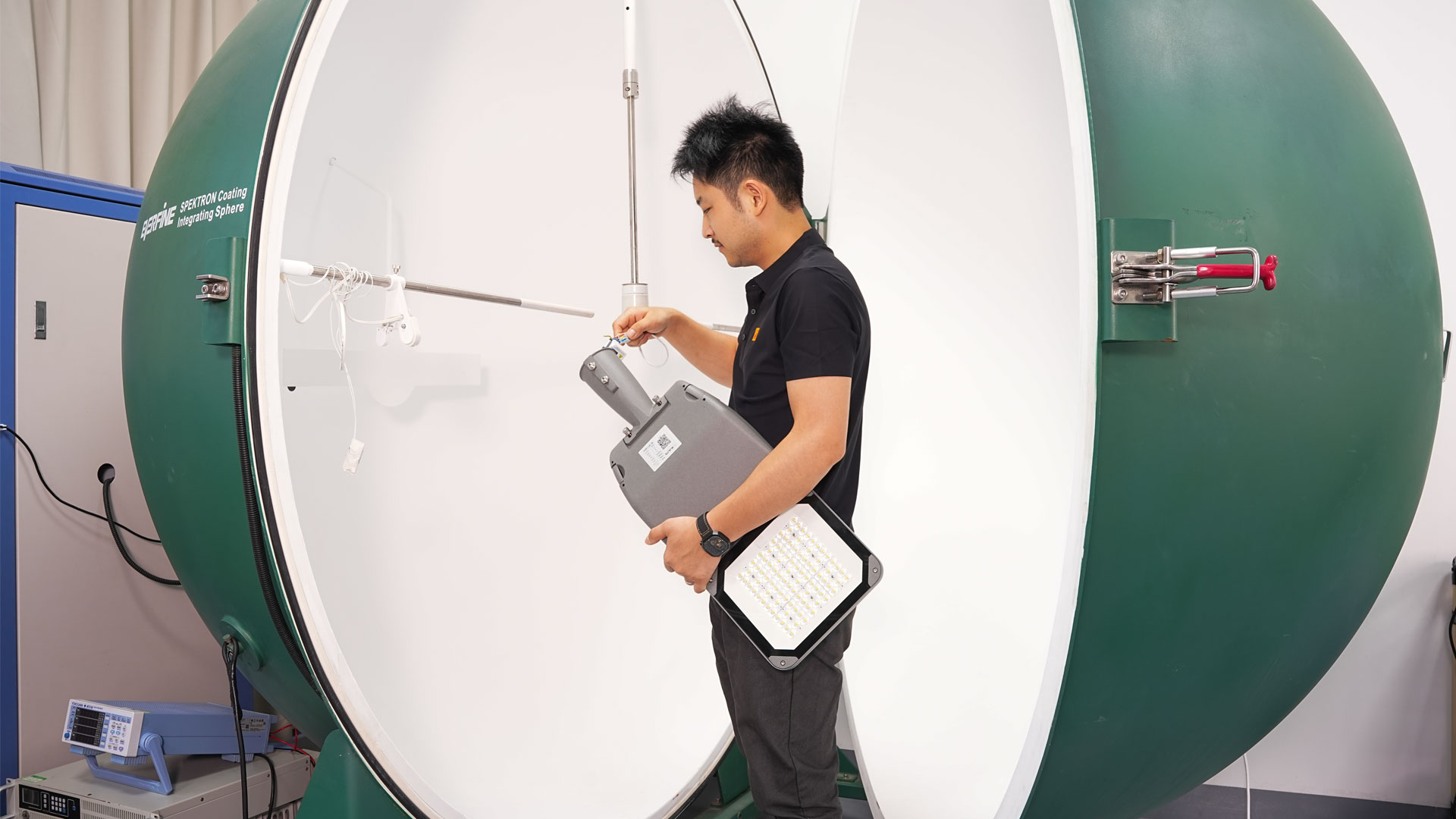
Specification note: “Up to 200 lm/W” is a series-level catalog maximum, not a guaranteed measurement for every ASL23 configuration. Use the matching test report when confirming project performance.
Optical Options for Different Road Layouts
The ASL23 brochure lists Type I, Type II and Type III distributions. These options allow designers to consider different ways of directing light along and across the target area.
Selecting an optic requires more than knowing the road category. Pole height, spacing, setback, road width, and mounting arrangement all influence the result. A narrow access road and a wider industrial estate road may need different distributions even when their luminaires operate at the same wattage.
Verify the Layout with Matching Photometric Data
Before placing a project order, use an IES or LDT photometric file matching the proposed configuration in a lighting calculation. DIALux or comparable software can help assess whether the layout meets the applicable project criteria, such as those based on EN 13201 or local requirements.
Design principle: Road lighting compliance depends on the designed installation and relevant verification—not simply on selecting a luminaire with a particular wattage or distribution label.
Outdoor Protection with Maintenance in Mind
Road luminaires face dust, rain, vibration, and temperature changes. The ASL23 brochure specifies IP66 ingress protection and IK10 impact protection, together with a die-cast aluminium body and anti-corrosion powder coating.
IP66 Ingress Protection
Addresses dust and water ingress under specified test conditions. IP66 does not indicate protection against continuous immersion.
IK10 Impact Protection
Addresses enclosure resistance to mechanical impact under specified test conditions. It does not mean the luminaire is damage-proof in every situation.
Neither rating alone establishes suitability for every coastal, chemical, or highly corrosive location. For demanding sites, confirm coating requirements, operating-temperature limits, and relevant corrosion-test documentation.
Tool-Free Driver-Compartment Access
Maintenance access is a practical part of long-term product selection. The ASL23 provides tool-free access to the driver compartment, and the brochure shows an anti-fall retaining rope. These details are useful when planning component access and servicing at height.
Tool-free access does not mean every repair is tool-free. Electrical isolation, safe access equipment, and qualified maintenance procedures remain necessary.
Adjustable Installation and Control Configuration
Mounting Adjustment from −15° to +10°
The ASL23 supports horizontal and vertical mounting arrangements, with adjustment from −15° to +10° in 5° steps. This provides flexibility when aligning the luminaire with the proposed lighting layout.
The final angle should follow the approved calculation. Additional tilt can change glare, spill light, and illumination on the road.
Photocell, NEMA and Zhaga Options
The brochure shows photocell, NEMA socket and Zhaga socket options. These are relevant when specifying automatic switching or connected lighting equipment, but a socket alone does not establish control functionality.
Before ordering, confirm:
- The socket variant and electrical configuration.
- The driver control interface.
- Controller compatibility and power requirements.
- The required switching, dimming, or monitoring functions.
Do not assume that a socket option automatically includes DALI, D4i, wireless connectivity, or a lighting-management platform. These functions require configuration-specific confirmation.
Specify the ASL23 Around Your Project
The ASL23 is worth considering for road lighting projects that need high catalog-rated efficacy, outdoor enclosure protection, and accessible electrical components.
To help select a suitable configuration, share the following information with Alite Lighting:
- Site geometry: Road width, pole height, spacing, and mounting arrangement.
- Lighting criteria: Applicable standards and project performance requirements.
- Light quality: Preferred colour temperature and colour rendering.
- Electrical requirements: Supply voltage and surge-protection requirements.
- Controls: Photocell, dimming, or connected-control requirements.
- Environment: Temperature conditions and coastal or corrosive exposure.
Before approval, request the matching product specification, photometric file, relevant test documentation, and lighting calculation for the proposed configuration.