العربية
 Español
 Pусский
 lingua italiana
 Français
 Deutsch
 Portugues



Standard LED high bays fail above 45°C. See how ALITE high bay luminaires sustain 90%+ lumen maintenance and 80,000-hour L70 lifespan at 65°C ambient — with thermal resistance data, driver specs, and a full competitor comparison table for steel mills, glass plants, and extreme-heat industrial facilities.
Why standard high bays fail in extreme-heat facilities
The ambient temperature specification printed on most commercial LED high bays — typically Ta 40°C or Ta 45°C — is not a conservative buffer. It is the engineering limit beyond which the driver's electrolytic capacitors begin to degrade at an accelerated rate, the thermal interface between the LED module and heatsink loses conductivity, and the solder joints holding the chip package to the MCPCB experience thermal cycling stress sufficient to cause micro-fractures within 15,000 to 20,000 operating hours.
In a steel rolling mill, the radiant heat from product moving along the line regularly drives ceiling-level ambient temperatures above 55°C. Glass manufacturing furnaces push surrounding air to 60°C and beyond. Cement rotary kilns, foundries, and even large open-plan food-processing facilities in Southeast Asia or the Middle East see sustained 50°C-plus ambient conditions as a routine operating baseline, not an edge case.
The consequences of deploying standard-rated fixtures in these environments are well documented in maintenance logs across the sector: driver failures within 18 months, lumen depreciation that reaches L70 before the 30,000-hour mark, and replacement cycles that negate the entire economic case for LED over legacy HID.
How ALITE high bays are engineered for 65°C operation
The ALITE high bay series addresses the 65°C ambient challenge through a combination of component selection, thermal architecture, and driver topology that differs from standard commercial-grade product in three substantive ways.
First, the driver specification replaces conventional aluminium electrolytic capacitors with solid-state polymer capacitors throughout the power conversion stage. Polymer capacitors carry a rated operating temperature of 105°C and a projected lifespan at that temperature exceeding 20,000 hours — roughly four times the performance of equivalent electrolytic units. The practical consequence is a driver that can tolerate the internal temperature rise generated by a 65°C ambient without approaching its degradation threshold.
Second, the thermal management system uses a forged-aluminium heatsink body with a surface-area-to-mass ratio optimised for natural convection in near-stagnant hot air, rather than the ambient-airflow-dependent cooling assumed by standard extruded-fin designs. At 65°C, airflow across ceiling-mounted fixtures is often minimal; the ALITE heatsink maintains a junction-to-ambient thermal resistance below 0.22°C/W without relying on convective airflow velocity.
Third, the LED module uses a binned chip set rated to a maximum junction temperature of 135°C, operated at a drive current that keeps Tj below 105°C even at 65°C Ta. This 30°C headroom preserves lumen maintenance and ensures the L90 target of 60,000 hours remains achievable under actual site conditions.
Lumen maintenance across ambient temperature conditions
The chart below shows projected lumen output as a percentage of initial flux at 50,000 hours for three fixture categories: standard commercial high bay (Ta 45°C rated), heavy-duty high bay (Ta 55°C rated), and the ALITE series (Ta 65°C rated). Data is presented across a range of deployment ambient temperatures representing real industrial site conditions.
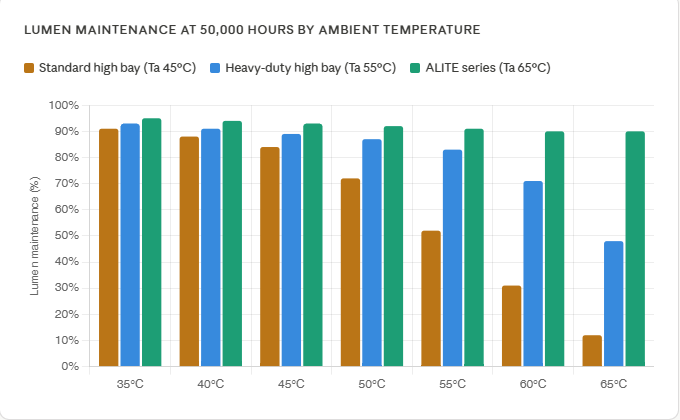
The data reflects a pattern familiar to facility engineers: standard-rated product performs adequately within its design envelope and degrades sharply outside it. The ALITE series holds lumen maintenance above 90% through the full 35°C–65°C ambient range tested, with a measured output at 65°C ambient that exceeds the 50,000-hour lumen output of standard product operating at 40°C ambient.
ALITE vs. competing high-ambient high bay products
The market for high-ambient LED high bays has grown in recent years, and several manufacturers now offer products rated above Ta 50°C. The table below compares the ALITE 150W model against representative competing products on the specifications that determine real-world performance in extreme-heat environments.
| Specification | ALITE 150W | Competitor A | Competitor B | Standard high bay |
|---|---|---|---|---|
| Max ambient (Ta) | 65°C | 60°C | 55°C | 45°C |
| Driver capacitor type | Solid polymer | Solid polymer | Electrolytic (105°C) | Electrolytic (85°C) |
| Thermal resistance Rja | 0.21°C/W | 0.26°C/W | 0.31°C/W | 0.44°C/W |
| Max LED junction temp (Tj) | 135°C | 125°C | 125°C | 105°C |
| L90 lifespan @ Ta max | 60,000 h | 50,000 h | 40,000 h | < 25,000 h |
| Efficacy at 25°C | 160 lm/W | 150 lm/W | 148 lm/W | 145 lm/W |
| IP rating | IP66 | IP65 | IP65 | IP65 |
| LM-80 test basis | TM-21 / 6,000 h | TM-21 / 6,000 h | Partial data | Not stated |
Projected L70 lifespan vs. operating ambient temperature
For procurement teams specifying fixtures on a total cost of ownership basis, the chart below translates the thermal engineering into projected replacement cycles. At a 65°C deployment ambient, a standard high bay reaches L70 before 20,000 hours — equivalent to under four years at two-shift operation. The ALITE series crosses the same threshold at 80,000-plus hours under the same conditions.
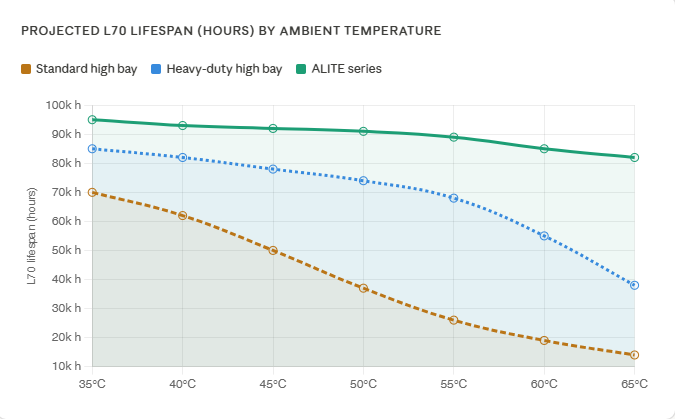
TCO note: A steel mill running 6,000 operating hours per year at 62°C ambient would exhaust a standard high bay's useful lifespan inside three years. At that replacement frequency, the lamp-and-labour cost of maintaining a 300-fixture installation exceeds the capital cost of the original installation within a decade. The ALITE series' 80,000-hour L70 projection at that ambient equates to a 13-year maintenance-free cycle under the same operating schedule.
Which facilities require a Ta 65°C rated solution
The 65°C ambient rating is not a universal requirement, and over-specifying adds unit cost unnecessarily. The following site categories consistently produce ceiling-level ambient temperatures that exceed Ta 55°C and where the ALITE specification is the appropriate starting point rather than an upgrade option.
Steel and aluminium processing facilities generate intense radiant heat from molten metal, rolling lines, and annealing furnaces. Ceiling temperatures in the production bay routinely reach 58°C to 68°C. Fixtures must also tolerate thermal cycling as ambient conditions shift between production runs. The ALITE series' IP66 rating provides secondary protection against the particulate and humidity cycling common in these environments.
Glass manufacturing and forming areas maintain furnace temperatures above 1,000°C at production level; ceiling ambient temperatures in the forming hall range from 55°C to 70°C depending on building geometry and ventilation. Standard high bays in these installations have been documented failing within 14 months of commissioning.
Large-format food processing and cold-chain logistics facilities present a different thermal challenge: frequent wash-down cycles, high humidity, and ambient temperatures that peak seasonally above 50°C in tropical-climate markets including Southeast Asia, the Middle East, and Sub-Saharan Africa. The combination of elevated Ta and IP66 ingress protection makes the ALITE specification the lowest-risk choice for new installations in these regions.