العربية
 Español
 Pусский
 lingua italiana
 Français
 Deutsch
 Portugues



Discover how industrial LED floodlights balance high lumen output with superior heat dissipation. Compare heatsink architectures, L70 lifespan data, and thermal resistance specs across wattage classes — with charts, tables, and procurement guidance for engineers and buyers.
Why thermal management defines product lifespan
LED chips do not fail the way incandescent bulbs do. There is no filament to burn through. Instead, performance degrades gradually as junction temperatures exceed the design threshold — a process the industry calls lumen depreciation. IES TM-21 defines L70 as the point at which a fixture retains 70% of its initial output. For a 150,000-lm sports lighting installation, that number matters more than the wattage printed on the housing.
Heat flows from the LED junction outward through a thermal interface material, into the heatsink, and finally into the surrounding air. Each transition point introduces thermal resistance. Industrial-grade fixtures are engineered to minimize this resistance across the entire chain, not merely at one point. A premium chip mounted on a substandard PCB with inadequate thermal paste will still fail early.
Lumen output vs. thermal resistance across power tiers
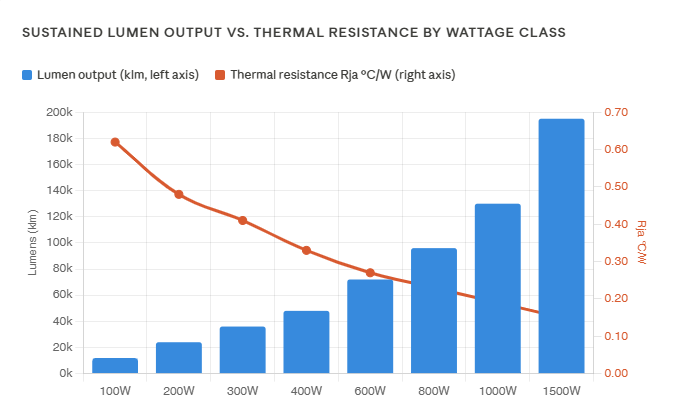
The chart below plots sustained lumen output against measured thermal resistance (junction-to-ambient, Rja) for common industrial LED floodlight power classes. Lower Rja values indicate more effective heat dissipation and consistently correspond to higher lumen maintenance at 50,000 hours.
Heatsink design strategies: a field comparison
Not all aluminum is the same, and not all fin configurations perform equally. The table below compares the four principal heatsink architectures used in industrial LED floodlights above 200W, drawing on manufacturer datasheets and third-party thermal imaging studies.
| Architecture | Rja (°C/W) | Weight penalty | Best application | Longevity rating |
|---|---|---|---|---|
| Die-cast radial fin | 0.28 – 0.35 | Moderate | 400W–600W general industrial | Excellent |
| Extruded linear fin | 0.35 – 0.45 | Low | 100W–300W commercial | Good |
| Forged + CNC machined | 0.18 – 0.25 | High | 600W–1500W stadiums, ports | Excellent |
| Heat pipe assisted | 0.12 – 0.20 | Very high | 1000W+ mission-critical | Superior |
| Sheet-metal stamped | 0.55 – 0.80 | Very low | Sub-100W entry-level only | Limited |
Forged aluminum, processed through high-pressure die casting followed by CNC fin cutting, achieves the highest surface-area-to-mass ratio of passive solutions. Heat pipe designs push further still — vapor-phase internal transport actively moves thermal energy away from the junction at rates passive conduction cannot match — but the added complexity raises both unit cost and the risk of failure modes absent in solid-state heatsinks.
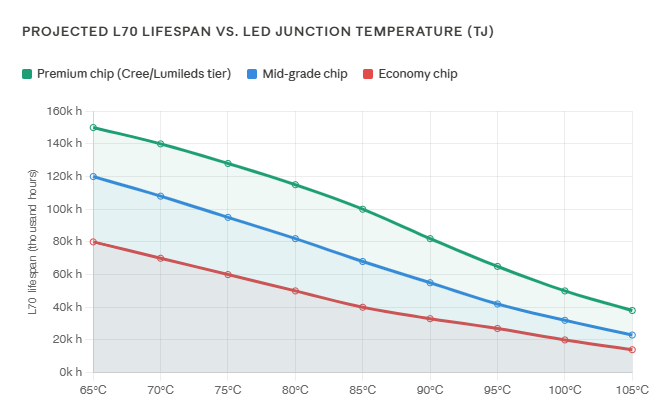
The second chart illustrates projected L70 lifespan (in thousands of hours) as junction temperature climbs from 65°C to 105°C, across three chip-quality tiers representing typical market segments.
What buyers should require from datasheets
Generic lumen figures without accompanying thermal data are commercially meaningless for procurement teams evaluating multi-year installations. The following are the minimum specification fields that allow meaningful comparison between competing products:
| Specification field | Why it matters | Red flag value |
|---|---|---|
| Tj (max junction temp) | Upper thermal limit of the LED chip — determines derating requirement | Not stated |
| Tc (case temperature) | Measurable field verification point; enables real-world thermal audit | Not stated |
| Rja or Rjc thermal resistance | Quantifies the heatsink's effectiveness independent of ambient conditions | Not stated |
| L70 test basis | TM-21 extrapolation from ≥6,000h LM-80 data is the minimum credible standard | No LM-80 reference |
| IP + IK rating | Ingress protection failures cause thermal compound contamination and early failure | IP65 only for coastal or dusty sites |
| Operating ambient (Ta max) | Must exceed the deployment environment; often understated in budget products | Ta max below 45°C for tropical sites |
Matching fixture architecture to site requirements
Industrial and commercial LED floodlight specifications are not uniform across application categories. A cold-storage warehouse running 10 hours per night at 5°C ambient imposes a fundamentally different thermal profile than a port terminal operating 24 hours at 42°C with salt-laden air. Three application profiles illustrate how specification priorities shift:
Sports and stadium lighting (500W–1500W): Sustained full-power operation during scheduled events demands forged or heat-pipe heatsinks. Wind-load calculations at 30–70m mast heights constrain heatsink geometry. Glare control optics (typically beam angles below 12°) concentrate light delivery but also concentrate thermal density at the chip array.
Port and logistics (300W–800W): Corrosive salt environments require IP66 minimum; IK10 impact resistance protects against indirect physical contact. Thermal interface material choice matters more in humid tropical climates, where differential expansion from humidity cycling degrades inferior materials.
Mining and heavy industry (200W–600W): ATEX or IECEx certification may be required in Zone 2 hazardous locations. Explosion-proof variants inherently limit heatsink surface area and airflow, making chip selection and thermal interface quality even more critical than in open-air installations.