العربية
 Español
 Pусский
 lingua italiana
 Français
 Deutsch
 Portugues



Beam angles are measured in degrees, and choosing the correct angle is critical to ensuring optimal lighting for a given space. Different beam angles are suited for specific applications, depending on factors like ceiling height, room size, and the lighting needs of the environment.
Common Beam Angles for UFO LED High Bay Lights
-
60 Degrees: This narrow beam angle focuses light on a smaller area, making it perfect for high ceilings (above 20 feet). It’s ideal for concentrated lighting in warehouses with tall shelving or manufacturing plants where specific work areas need targeted illumination.
-
90 Degrees: Offering a balance between concentrated and widespread light, a 90-degree beam angle is best suited for ceilings between 15 to 20 feet. It provides adequate coverage in general lighting applications such as gymnasiums, retail stores, and medium-height warehouses.
-
120 Degrees: A wide beam angle, best for lower ceilings (below 15 feet), effectively distributes light over large open spaces like supermarkets, big-box stores, and open warehouses. It ensures a broad, uniform light spread with minimal shadows.
-
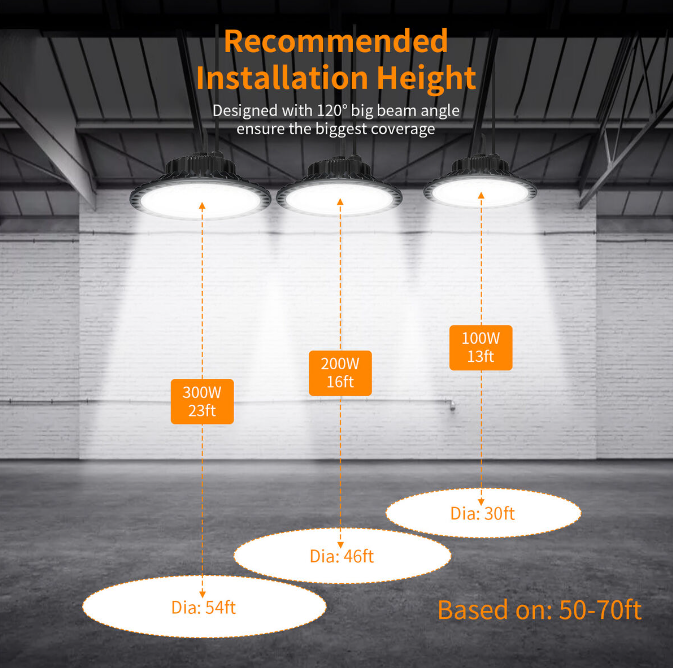
How to Choose the Right Beam Angle
-
Ceiling Height: As a rule of thumb, the higher the ceiling, the narrower the beam angle should be. Narrow beam angles help direct light downward without losing intensity, making them suitable for tall spaces. Conversely, lower ceilings benefit from wider beam angles to ensure even light distribution.
-
Lighting Purpose: For task-specific lighting, such as illuminating workbenches or machinery, a 60-degree beam angle is ideal. In contrast, for general ambient lighting, especially in wide, open areas, a wider angle of 120 degrees is more appropriate.
-
Space Size: In larger spaces, using wider beam angles can help reduce the number of fixtures needed while ensuring uniform lighting. This saves costs and enhances energy efficiency.

-
Area: The total size of the room in square feet.
-
Foot Candles: The amount of light required for the space (usually between 10–30 foot candles for warehouses, and 30–50 for retail or industrial workspaces).
Why Is the Beam Angle Important in High Bay Lighting?
How Does Ceiling Height Affect Beam Angle Choice?
Can the Beam Angle of UFO High Bay Lights Be Adjusted?
What Is the Difference Between a Beam Angle and a Field Angle?
How to Calculate the Number of Fixtures Based on Beam Angle

Where:
-
Total Lumens Required: The total lumens calculated based on the size of the area.
-
Lumens per Fixture: The lumen output of a single UFO high bay light.
How Does Beam Angle Impact Energy Efficiency?
What Wattage Do You Need for High Bay Lights?
Wattage plays a crucial role in determining the brightness and energy efficiency of your high bay lights. Typically, the higher the ceiling, the more wattage you’ll need to ensure adequate brightness. Use this formula to calculate wattage based on your space:

Where:
-
Lumens per Watt: The efficiency of the light fixture (usually ranging from 130 to 150 lumens per watt for high-quality LED high bay lights).
Enter values below to calculate
What Are the Best Beam Angles for Different Applications?
-
Warehouses and Manufacturing Plants: These spaces often have high ceilings and require task lighting, making narrower beam angles (60 degrees) ideal for focused light on specific work areas.
-
Gymnasiums and Large Retail Stores: Medium ceiling heights and general lighting needs make 90-degree beam angles suitable, offering both focus and broader coverage.
-
Supermarkets and Big-Box Stores: For lower ceilings and open spaces, a 120-degree beam angle is best for distributing light evenly across wide areas.