العربية
 Español
 Pусский
 lingua italiana
 Français
 Deutsch
 Portugues



A fundamental guideline for spacing is that the height of the LED fixtures should equal the distance between them. For example, if lights are mounted at a height of 20 feet, they should also be spaced 20 feet apart.

LED UFO High Bay Lights Space
LED UFO High Bay Lights Layouts Calculate
However, it’s crucial to remember that this calculator serves as an approximation tool and should not replace a comprehensive lighting plan or photometric design. While it provides valuable guidance, it does not account for specific factors such as light placement, distribution, or precise foot candle ratios. Therefore, use it as a directional resource to enhance your overall lighting strategy.
What Total Number of LED UFO High Bay Lights Should We Have?
For warehouses requiring LED high bay lights, you typically have two options: you can either replace existing metal halide lights or install new LED fixtures. Each choice has its benefits, and understanding the unique needs of your space will help you make an informed decision that enhances both efficiency and illumination.

If your space requires a total of 8000 watts, you would only need eight 400-watt LED high bay lights to achieve the desired illumination. This shift not only enhances the quality of light in your environment but also reduces energy consumption, resulting in lower utility bills over time.
- 10-15 feet high needs 10,000-15,000 lumens of lights
- 15-20 feet high needs 16,000 to 20,000 lumens of lights
- 25-35 feet high needs 33,000 lumens of lights
As a general guideline, a light fixture installed at a height of 15 feet can effectively illuminate a space of 12 feet in width. For lights mounted at 20 feet, they can brighten an area of 15 feet, with an ideal brightness typically observed at 18 feet. Similarly, lights positioned at 30 feet can illuminate a space of 20 feet, providing optimal brightness at a distance of 25 feet. This careful consideration of spacing ensures both energy efficiency and effective lighting throughout the area.
Desired LED High Bay Light Space
A wide range of LED high bay lights is available for purchase, each offering different wattages and lumen outputs. Here are some common options:
- 60 watts with 8,100 lumens
- 100 watts with 13,000 to 14,000 lumens
- 150 watts with 20,000 to 21,000 lumens
- 200 watts with 27,000 to 28,000 lumens
- 250 watts with 30,000 to 35,000 lumens
While it’s important to consider the brightness and wattage of these LED high bay lights, spacing is also a crucial factor. To determine the best fit for your space, you should also evaluate installation height and the wattage of the lights being used.
Here are the recommended wattages based on installation height:
- For heights of 0 to 9 feet, the recommendation is 60 watts.
- For heights of 10 to 15 feet, the recommendation is 100 watts.
- For heights of 14 to 18 feet, the recommendation is 150 watts.
- For heights of 18 to 20 feet, the recommendation is 200 watts.
- For heights of 21 feet and above, the recommendation is 240 watts.
This careful consideration ensures that you achieve optimal lighting for your specific environment.
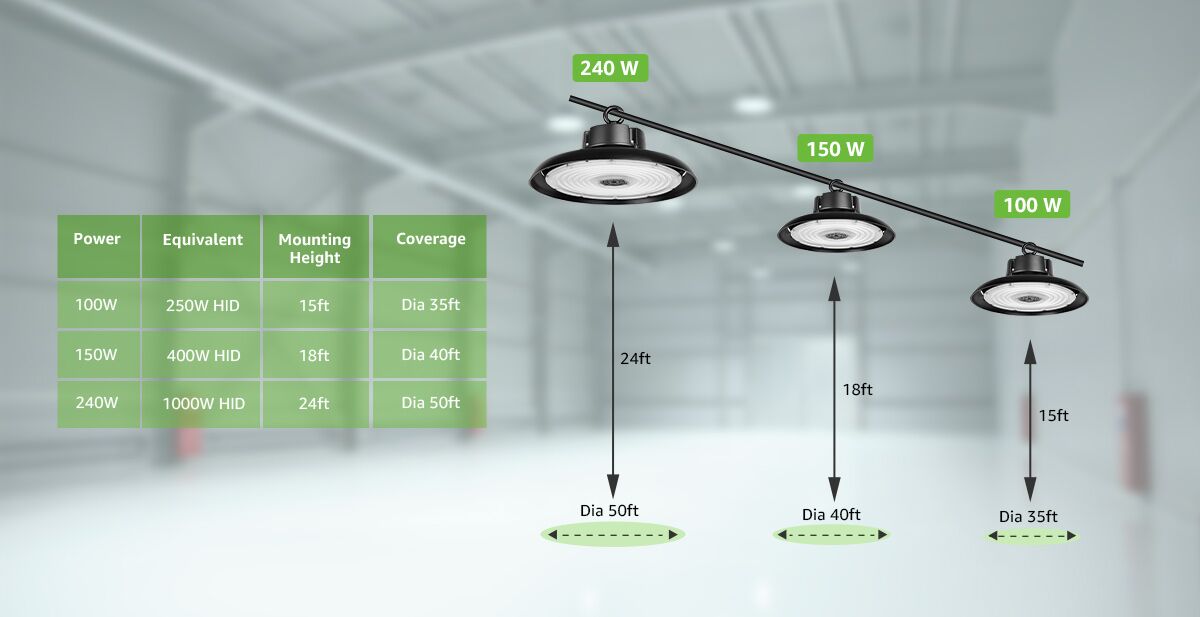
High Bay Lighting Space and Distance of Installation
- 15 to 19 Feet High: For factory lighting, position your LED high bay lights approximately 10 to 12 feet apart. To achieve normal, uniform lighting, maintain a distance of around 14 feet between fixtures.
- 20 to 29 Feet High: If you require additional illumination in the area, space the light fixtures about 20 feet apart. For standard lighting conditions, a distance of 14 feet is still advisable. Keep in mind that greater heights may necessitate the installation of more LED high bay lights.
- 30+ Feet High: In facilities with high ceilings, light fixtures should be spaced approximately 20 feet apart to ensure adequate brightness. For optimal lighting and bright conditions, a spacing of 25 feet is ideal, with a lumen output ranging from 400 to 1,000 watts to achieve the desired level of illumination.
How to Determine LED UFO High Bay Lights Layout
When installing lights, consider the following two aspects:
- Lighting Type: Choose the appropriate type of lighting for your needs, whether it’s general lighting, localized lighting, or a combination of both.
- Light Selection: Assess which lighting options are best suited for your area. Always opt for LED lights that are waterproof, dustproof, and explosion-proof to ensure durability and safety in the workplace.