العربية
 Español
 Pусский
 lingua italiana
 Français
 Deutsch
 Portugues



Complete specification guide for dark-sky compliant outdoor lighting. Covers IDA standards, CCT requirements, BUG ratings, cost analysis, and implementation strategies for municipal and commercial installations. Includes technical comparison tables and ROI data.
Municipal lighting directors and commercial facility managers face mounting pressure to balance public safety requirements with environmental responsibility. This specification guide provides actionable technical criteria for selecting, specifying, and implementing dark-sky compliant outdoor lighting systems that meet both operational demands and increasingly stringent light pollution ordinances.
The Business Case for Dark-Sky Compliance
Light pollution affects more than 80 percent of the global population, with North American and European urban centers experiencing the most severe sky glow conditions. Beyond astronomical concerns, poorly designed outdoor lighting creates measurable impacts on municipal budgets, public health, and ecosystem stability.
Research published in the Journal of Environmental Management indicates that municipalities implementing dark-sky compliant lighting retrofits typically achieve 40 to 60 percent reductions in energy consumption. These savings stem not from reduced illumination levels, but from eliminating wasted light that escapes above the horizontal plane or spills beyond intended target areas.

Understanding IDA Standards and Certification Tiers
The International Dark-Sky Association maintains the most widely recognized certification program for outdoor lighting fixtures. Their Fixture Seal of Approval program evaluates products across multiple criteria, with particular emphasis on light distribution patterns and spectral composition.
Certification requires fixtures to emit zero light above 90 degrees from nadir and maintain correlated color temperatures at or below 3000 Kelvin. These requirements address the two primary mechanisms of artificial sky glow: direct uplight emission and atmospheric scattering of short-wavelength radiation.

Technical Specifications: CCT, BUG Ratings, and Shielding
Effective dark-sky specifications require attention to three interconnected parameters: correlated color temperature, BUG ratings (Backlight-Uplight-Glare), and physical shielding configurations. Each parameter addresses distinct mechanisms of light pollution and visual comfort degradation.
Correlated Color Temperature Requirements
Color temperature specifications directly influence both sky glow intensity and biological impacts on humans and wildlife. Lower CCT values indicate warmer light with reduced short-wavelength content. The atmospheric scattering coefficient for blue light (450nm) exceeds that of amber wavelengths (590nm) by a factor of approximately 5.5, making spectral composition a primary concern for sky glow mitigation.
Specification Recommendation
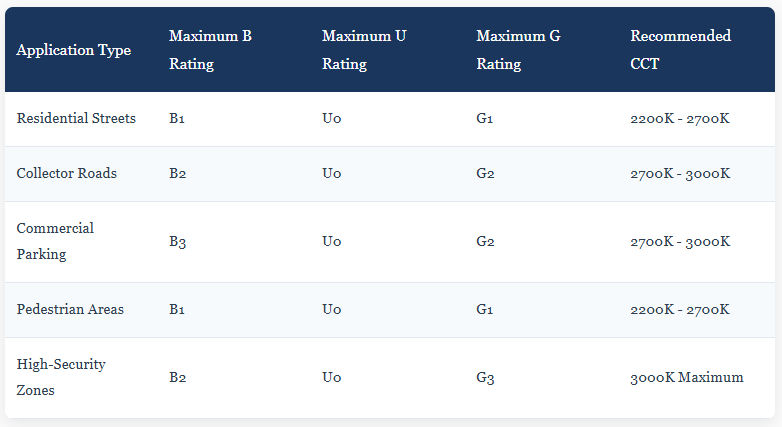
For general municipal applications, specify fixtures with CCT values between 2200K and 2700K. Reserve 3000K fixtures for high-security areas where enhanced color rendering supports surveillance camera effectiveness. Avoid specifications permitting CCT values above 3000K regardless of manufacturer claims regarding efficiency advantages.
BUG Rating System
The Illuminating Engineering Society BUG rating system provides standardized metrics for evaluating luminaire light distribution. Each component receives a rating from 0 to 5, with lower values indicating better control. Dark-sky compliant specifications typically require U0 ratings (zero uplight) and carefully considered B and G values based on mounting height and setback distances.
Fixture Comparison: Traditional vs. Dark-Sky Compliant
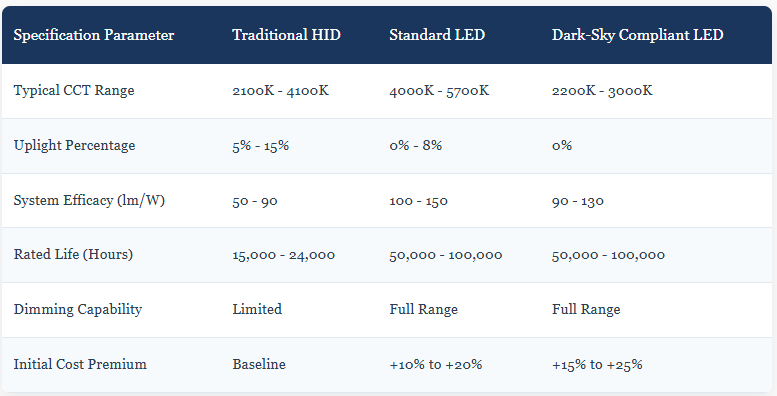
The transition from legacy high-intensity discharge fixtures to modern dark-sky compliant LED systems involves tradeoffs that specification writers must understand. While initial fixture costs for compliant products may exceed conventional alternatives by 15 to 25 percent, lifecycle cost analysis consistently favors the compliant option.

Figure 2: Lifecycle cost analysis including fixture acquisition, installation, energy consumption, and maintenance. Based on 4,380 annual operating hours.
Implementation Strategies for Municipal Projects
Successful dark-sky compliant lighting programs require coordinated approaches spanning procurement specifications, installation standards, and ongoing maintenance protocols. Municipalities achieving the strongest results typically begin with pilot programs in residential neighborhoods before expanding to commercial corridors and high-traffic arterials.
Phased Retrofit Approach
Rather than pursuing comprehensive single-phase conversions, consider a prioritized retrofit sequence that addresses the highest-impact fixtures first. This approach allows maintenance staff to develop familiarity with new fixture types while demonstrating measurable results to stakeholders.
- Phase 1: Replace unshielded decorative fixtures in parks and civic spaces
- Phase 2: Convert residential street lighting to fully shielded LED
- Phase 3: Address commercial corridor and arterial roadway fixtures
- Phase 4: Implement adaptive controls and dimming schedules
Specification Language
Include explicit performance requirements in procurement documents rather than relying on manufacturer certifications alone. Specify photometric testing requirements using IES LM-79 protocols and require submittals demonstrating compliance with stated BUG ratings.
Cost Analysis and Long-Term ROI
Financial justification for dark-sky compliant lighting extends beyond direct energy savings. Municipalities report reduced light trespass complaints, lower liability exposure from glare-related incidents, and improved community satisfaction scores following compliant retrofits.

Figure 3: Comparative annual energy consumption based on equivalent illumination levels. Assumes 4,380 annual operating hours with 50% dimming during off-peak periods for LED fixtures.
Utility rebate programs increasingly favor dark-sky compliant products, with some programs offering enhanced incentives for fixtures meeting IDA certification standards. Contact regional utility representatives to identify available incentive structures before finalizing specifications.
Key Takeaways for Specification Writers
Prioritize fixtures with U0 ratings regardless of application type. Specify CCT values at or below 3000K, with preference for 2700K in most municipal applications. Require full photometric documentation and third-party BUG rating verification. Consider adaptive control systems that enable post-installation optimization based on actual usage patterns.