العربية
 Español
 Pусский
 lingua italiana
 Français
 Deutsch
 Portugues




Padel court LED
lighting in 2026
Lux, uniformity, pole height & a practical B2B procurement checklist.
Outdoor recreation & training
Uniformity ≥ 0.5
Outdoor national / international play
Uniformity ≥ 0.7
TV broadcast · vertical illuminance
Camera requirements apply
Request the exact optic file
Verify it against the ordered model
Why padel needs a lighting specification
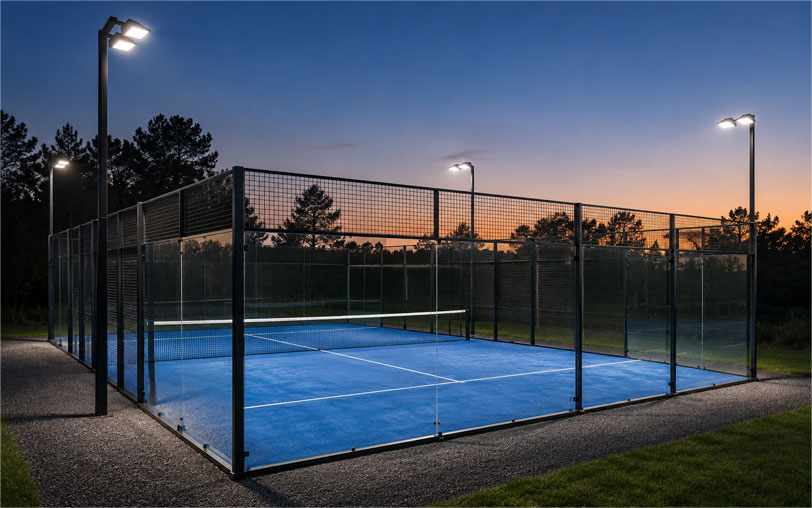
Padel creates a demanding visual task in a compact enclosure. Players track a fast ball against glass, mesh, sky, walls, and advertising surfaces, often while looking upward. A project can therefore reach an average lux target and still feel poor if it has dark patches, visible high-luminance sources, reflections in the glass, or excessive spill beyond the site boundary.
For buyers, contractors, and club operators, the safest procurement approach is performance-led. Define the required maintained illuminance and uniformity, establish where and how they will be measured, and require a photometric calculation based on the actual court geometry. Then evaluate the proposed floodlights, optics, aiming, mounting arrangement, controls, and evidence package as one system.
Lux and uniformity by playing level
The FIP Beyond Rulebook sets different minimum levels for outdoor and indoor courts. For outdoor local competition, training, school, and recreational use, it lists 200 lux horizontal illuminance with 0.5 uniformity. Outdoor national and international competition rises to 500 lux with 0.7 uniformity. Indoor values are 300 lux and 750 lux respectively, with the same two uniformity thresholds. Television broadcasting introduces a separate vertical illuminance requirement of at least 1,000 lux, which may increase with camera distance.
These categories should not be blended into one generic “padel court wattage” answer. The playing level changes the target, and a camera requirement uses a different measurement plane. The SAPCA code published through the Lawn Tennis Association also calls for a 1 m by 1 m calculation grid over the playing area and recommends a 0.9 maintenance factor to allow for light loss over time.
| Court / use category | Illuminance | Uniformity |
|---|---|---|
| Outdoor · local competition, training, school & recreation | 200 lxHorizontal | ≥ 0.5 |
| Outdoor · national & international competition | 500 lxHorizontal | ≥ 0.7 |
| Indoor · local competition, training, school & recreation | 300 lxHorizontal | ≥ 0.5 |
| Indoor · national & international competition | 750 lxHorizontal | ≥ 0.7 |
| Television broadcast | 1,000 lx+Vertical | Project specific |
Read the measurement plane. Court lux is horizontal; broadcast lux is vertical. Uniformity is Emin / Eavg. Confirm the governing local rules and the agreed project brief.
Geometry matters as much as lumens
The FIP game regulations state that artificial lighting must be uniform and must not impair the vision of players, officials, or spectators. They place poles outside the court and set a minimum projector height of 6 m. For new facilities with lights inside the vertical projection of the side walls, an 8 m minimum is suggested. These rules affect both safety and aiming: pole positions, luminaire tilt, glass reflections, and player sightlines must be resolved together.
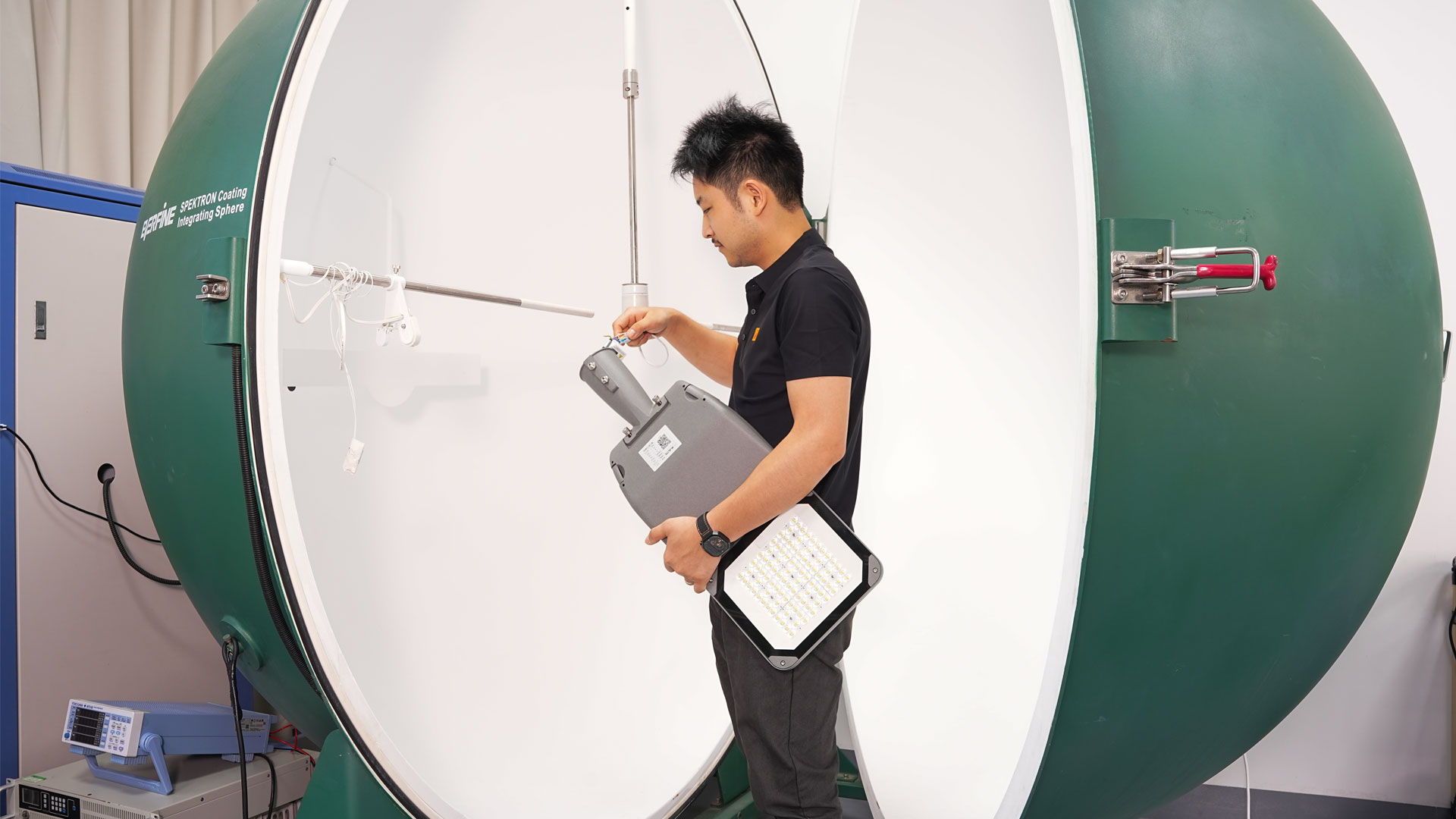
A useful design submission should show the court plan, pole coordinates and heights, luminaire quantity, mounting orientation, aiming points, calculation grid, average and minimum values, uniformity, maintenance factor, and boundary checks where local obtrusive-light rules apply. Buyers should also request the IES or LDT file used in the calculation and confirm that it matches the exact ordered optic.
Evaluating Alite floodlights for your project
Alite Lighting supplies outdoor LED products to lighting companies, contractors, distributors, and project buyers, supported by technical documentation and project matching. For a padel project, the relevant starting point is the LED floodlight and sports-lighting portfolio, but model selection must follow a site-specific photometric design.
The AFL60 product page lists 50–600 W variants, 30°, 60°, and 90° beam options, 2,400–5,000 K CCT choices, IP65 and IK08 protection, and efficacy up to 160 lm/W. The modular AFL84 range lists 100–1,000 W configurations, including a 70° × 140° asymmetric option, IP66 and IK08 protection, and efficacy up to 170 lm/W. These published options make the families candidates for photometric evaluation; they do not by themselves guarantee a padel result.
A practical RFQ to Alite should therefore provide the court drawing, required playing level, pole arrangement, supply voltage, local spill-light limits, preferred CCT, control strategy, and any camera requirement. Ask Alite to return the proposed model and optic, IES/LDT file, calculation report, driver and surge configuration, installation details, and a clear list of assumptions. Final approval should use the latest project-specific data sheet rather than a web summary.
Product images show representative configurations. Confirm the exact variant and latest project-specific data sheet before ordering.
Commissioning and field acceptance
Commissioning closes the gap between the simulation and the installed system. Before measurement, verify pole positions, mounting heights, aiming angles, control settings, and any shields. Measurements should follow the agreed grid and operating conditions. Record average, minimum, and maximum readings, then calculate the specified uniformity ratio. Where neighbours, roads, or planning conditions are relevant, perform the agreed boundary or viewpoint checks as well.
If the field result misses the target, do not immediately increase wattage. First check aiming, control settings, supply conditions, obstructions, incorrect optics, and installation tolerances. A small aiming correction can improve uniformity, while simply adding output may increase glare and spill without fixing dark areas.
Frequently asked questions
How many watts does a padel court need?
There is no reliable universal wattage. Required power depends on the playing level, luminaire efficacy and optic, pole geometry, aiming, maintenance factor, and spill constraints. Use a project-specific photometric calculation.
What lux level is required for an outdoor padel court?
FIP lists 200 lux with 0.5 uniformity for outdoor local competition, training, school, and recreational use, and 500 lux with 0.7 uniformity for national and international competition.[1] Confirm the governing local rules and project brief.
Is IP65 enough for padel floodlights?
IP65 can be appropriate for many outdoor installations, but the project should also evaluate impact resistance, corrosion exposure, surge protection, ambient temperature, mounting hardware, and maintenance access. The required evidence depends on the environment and local electrical rules.
Can one luminaire family serve every padel project?
Not automatically. A family with multiple wattages and optics gives the designer more options, but every selected configuration still needs verified photometry and a layout that meets the required illuminance, uniformity, glare, and spill criteria.