العربية
 Español
 Pусский
 lingua italiana
 Français
 Deutsch
 Portugues



Compare all-in-one and split solar street lights in performance, cost, lifespan, and applications. A practical B2B guide for projects, distributors, and tenders.
Introduction: Why This Comparison Matters
Solar street lighting has become a mainstream solution for municipalities, contractors, and developers seeking energy independence, lower operating costs, and rapid deployment. However, buyers are often faced with a fundamental decision:
Should you choose an All-in-One (Integrated) Solar Street Light or a Split Solar Street Light system?
Both technologies are mature, but they serve very different project requirements. Selecting the wrong type can lead to underperformance, shortened lifespan, or unnecessary cost. This guide provides a clear, technical, and procurement-oriented comparison to help buyers make the right decision.
What Is an All-in-One Solar Street Light?
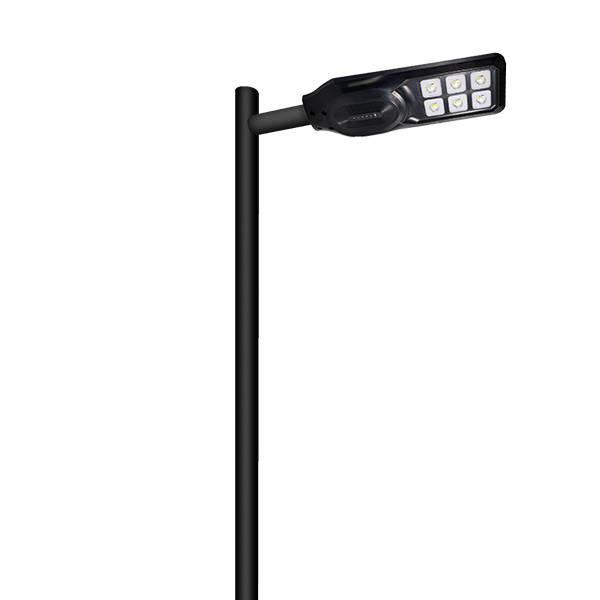
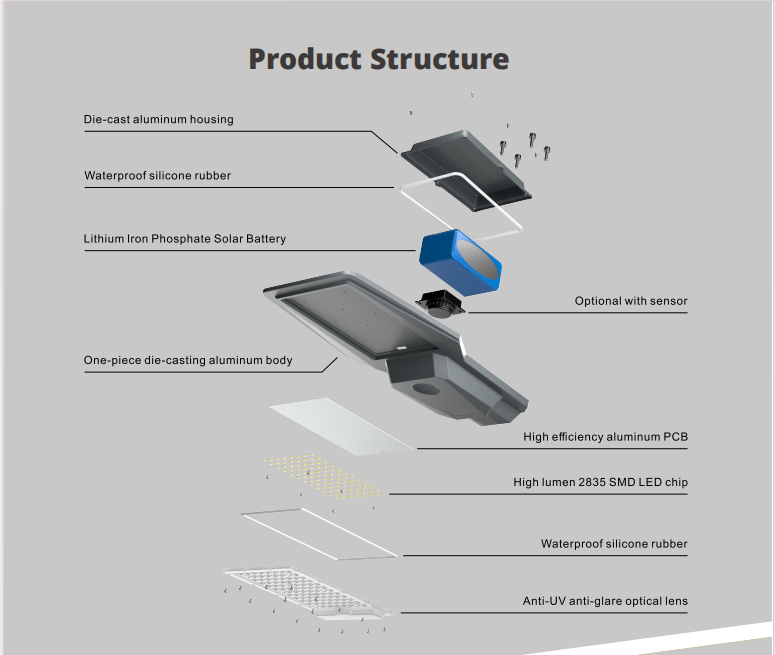
An All-in-One Solar Street Light integrates solar panel, lithium battery, LED luminaire, controller, and sometimes motion sensor into a single compact housing.
Key Characteristics
-
Fully integrated structure
-
Pre-configured at factory
-
Typically lithium (LiFePO₄) battery
-
Compact and modern design
-
Plug-and-play installation
Typical Power Range
-
20W–120W (LED output dependent on efficiency and control logic)
What Is a Split Solar Street Light?
Key Characteristics
-
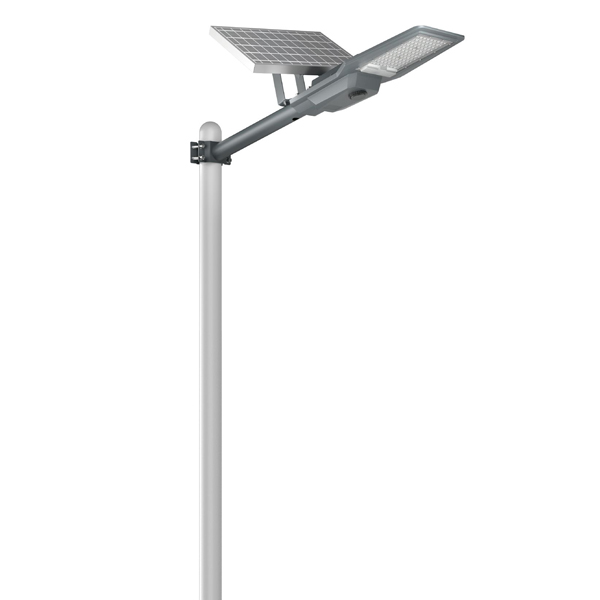
Modular architecture
-
Flexible system sizing
-
Battery often housed in a pole box or underground
-
Supports higher power outputs
-
Greater design and configuration freedom
Typical Power Range
-
30W–300W+ (project-dependent)
Core Differences at a Glance
| Aspect | All-in-One | Split Type |
|---|---|---|
| Structure | Fully integrated | Modular / separated |
| Installation | Very fast | More complex |
| Design Flexibility | Limited | High |
| Power Capacity | Low to medium | Medium to high |
| Battery Size | Limited by housing | Large, customizable |
| Maintenance | Replace entire unit | Replace components |
| Initial Cost | Lower | Higher |
| Ideal Use | Small roads, parks | Main roads, highways |
Performance Comparison: Real-World Impact
1. Lighting Output & Coverage
-
All-in-One:
Suitable for low-traffic roads, walkways, rural streets, and residential areas. Light distribution is optimized but constrained by compact optics and power limits. -
Split Type:
Designed for wide roads, high poles, intersections, and industrial areas. Larger LED modules and higher lumen packages provide superior uniformity.
Buyer Insight:
If pole height exceeds 8–9 meters or road width is over 12 meters, split systems usually perform better.
2. Battery Capacity & Autonomy
-
All-in-One:
Limited internal space restricts battery capacity. Typically designed for 2–3 nights autonomy. -
Split Type:
Battery size can be scaled for 5–7 nights autonomy, making it ideal for regions with poor solar conditions or long rainy seasons.
Buyer Insight:
For Africa, Latin America, or coastal regions with seasonal weather volatility, split systems provide higher reliability.
3. Solar Panel Efficiency & Orientation
-
All-in-One:
Panel angle is fixed. Performance may drop if installation orientation is not optimal. -
Split Type:
Panels can be tilted and oriented for maximum solar gain based on latitude.
Buyer Insight:
Projects above or below ±20° latitude benefit significantly from adjustable panel angles.
Installation & Project Deployment
All-in-One: Speed and Simplicity
-
No trenching
-
Minimal wiring
-
One-person installation possible
-
Ideal for emergency projects or fast rollouts
Split Type: Engineering-Driven Deployment
-
Requires cable routing
-
Battery box installation
-
Longer commissioning time
-
Suitable for planned infrastructure projects
Procurement Note:
Labor cost savings often make all-in-one systems more economical for small projects.
Maintenance & Lifecycle Cost
All-in-One
-
Fewer exposed components
-
Lower vandalism risk
-
Battery replacement may require full unit disassembly
Split Type
-
Individual component replacement
-
Easier battery servicing
-
Higher exposure to theft if battery box is accessible
Lifecycle Cost Insight:
Split systems typically have lower long-term maintenance cost in large-scale projects despite higher upfront investment.
Smart Control & Future Upgrades
| Feature | All-in-One | Split Type |
|---|---|---|
| PIR Motion Sensor | Standard | Optional |
| Dimming Profiles | Basic | Advanced |
| Remote Monitoring | Limited | Full IoT ready |
| System Expansion | No | Yes |
Split systems are better suited for smart city integration, including:
-
LoRa / NB-IoT controllers
-
Central management platforms
-
Adaptive lighting policies
Application-Based Recommendation
Choose All-in-One if:
-
Budget is limited
-
Project scale is small
-
Installation speed is critical
-
Roads are narrow or low-traffic
-
Aesthetic design matters
Choose Split Type if:
-
Project involves main roads or highways
-
High lumen output is required
-
Long autonomy is mandatory
-
Smart city integration is planned
-
Government or utility tender specifications apply
Common Buyer Mistakes to Avoid
-
Selecting all-in-one for high-mast roads
-
Ignoring autonomy requirements in rainy regions
-
Oversizing split systems unnecessarily
-
Comparing only wattage instead of lumens + autonomy + control logic
-
Not considering battery replacement accessibility
Cost Comparison (Indicative)
| Cost Factor | All-in-One | Split Type |
|---|---|---|
| Product Cost | Lower | Higher |
| Installation | Very low | Medium |
| Maintenance | Medium | Low |
| 5-Year TCO | Low (small projects) | Lower (large projects) |
Final Verdict: Which One Should You Buy?
There is no universal winner.
-
All-in-One solar street lights excel in speed, simplicity, and cost efficiency for small-to-medium projects.
-
Split solar street lights dominate in performance, scalability, and long-term reliability for professional infrastructure deployments.
The correct choice depends on road class, pole height, climate, autonomy requirement, and project lifecycle strategy—not marketing labels or wattage numbers.