العربية
 Español
 Pусский
 lingua italiana
 Français
 Deutsch
 Portugues



Learn what LM-79, LM-80 and TM-21 prove, what they do not prove, and how B2B buyers can verify outdoor LED lighting performance and lifetime claims.
Outdoor Lighting Specification Guide
How to Verify Outdoor LED Lifetime Claims: An LM-79, LM-80 and TM-21 Procurement Guide
A practical evidence guide for contractors, distributors, municipal buyers, engineers and project procurement teams comparing outdoor LED luminaires.
For a road, industrial yard, parking area or public-space project, the practical task is not to ask, “Do you have LM-80?” It is to connect each supplier claim to the correct report, confirm that the tested configuration matches the quoted luminaire, and separately evaluate the driver, thermal path, seals, surge protection, controls and production consistency.
Why “50,000 Hours” Is Not a Complete Procurement Statement
LED products usually fade gradually rather than behaving like a conventional lamp that simply burns out. That makes lumen maintenance useful, but it also creates a common purchasing trap: a source-level projection is presented as the lifetime of the entire fixture. The Illuminating Engineering Society states that LM-80 and TM-21 evaluate LED components, while complete-luminaire reliability depends on additional mechanisms, including drive circuitry and secondary optical components.
The U.S. Department of Energy makes the same systems-level point. A luminaire can suffer catastrophic failure, excessive lumen depreciation or unacceptable color shift, and its electronics may fail before the LED source reaches its projected depreciation point. For outdoor projects, exposure to heat, moisture, voltage events, vibration, contaminants and control accessories adds more variables. A meaningful specification must distinguish maintained light output from complete-system survival.
Procurement risk: A long TM-21 projection can be valid for the LED source and still be insufficient evidence for the complete luminaire. Driver, thermal, sealing, optical and control-system evidence must be reviewed separately.
What Each Standard Actually Tells the Buyer
| Document | Test object | What it supports | What it does not prove |
|---|---|---|---|
| ANSI/IES LM-79-24 | Complete solid-state lighting product | Initial flux, power, efficacy, intensity distribution and color quantities under standard test conditions. | Long-term lumen maintenance or complete-system life |
| ANSI/IES LM-80-21 | LED package, array or module | Measured luminous-flux and color maintenance under controlled conditions. | Performance of the finished housing, driver, gasket, optics or controls |
| ANSI/IES TM-21-21 | Projection based on LM-80 data | Projected long-term flux maintenance of the LED source, with stated temperature, drive-current and extrapolation limits. | Warranty duration, failure rate or total luminaire lifetime |
Table 1. Claim-to-evidence map based on current IES descriptions of LM-79, LM-80 and TM-21.
LM-79: Verify the Offered Luminaire, Not a Similar Family Model
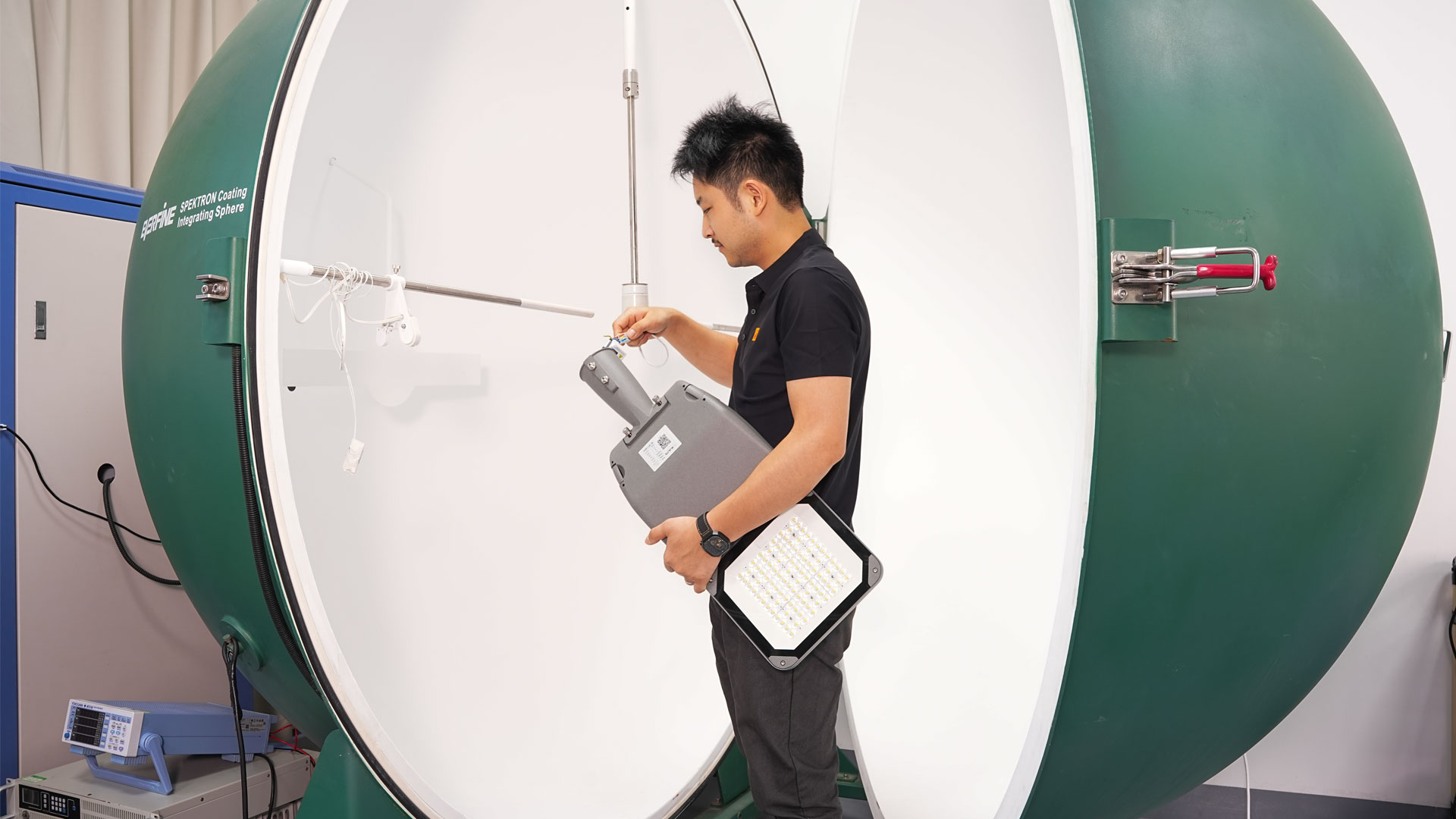
The current LM-79 edition describes procedures for reproducible measurements of total luminous flux, electrical power, system efficacy, intensity distribution and color quantities for solid-state lighting products.In a B2B review, the report should be checked against the exact model code, wattage, optical distribution, correlated color temperature, input conditions and driver configuration offered in the quotation.
This matters because a report for one variant does not automatically validate every member of a product family. If a street light is offered with several wattages or optics, request the report and photometric file relevant to the selected configuration. Use LM-79 results to verify the starting point for lighting calculations; do not use them as a substitute for service-life evidence.
LM-80: Check the Source and Its Operating Conditions
LM-80-21 provides methods for measuring flux and color maintenance of LED packages, arrays and modules under controlled conditions.The buyer should identify the LED source used in production, review the test temperatures and drive levels, and ask how the luminaire’s in-situ operating condition relates to those data. A credible review links the source report to the actual bill of materials and thermal design.
LM-80 is strong evidence for the LED source, but it does not test the complete outdoor fixture. It says nothing directly about the power supply, wiring, connector, gasket, coating, lens, photocell or network node. Those items require their own product evidence and quality controls.
TM-21: Read the Projection, Conditions and Limit
TM-21-21 provides the method for projecting long-term flux maintenance from LM-80 data. The projection depends on variables including operating temperature, drive current, source technology and the duration of the measured dataset.Buyers should ask for the full calculation output rather than accepting a brochure line such as “100,000-hour life.”
IES has specifically warned against treating TM-21 as a complete-luminaire lifetime model. Its published position also explains the historical 6× extrapolation limit: for example, 10,000 hours of LM-80 data could not support a reported projection beyond 60,000 hours under that rule.Current submittals should identify the TM-21 edition, input data, test duration, drive current, temperature basis and reported projection notation.
The Evidence Chain Behind an Outdoor LED Claim
A Seven-Step RFQ Verification Workflow
Freeze the offered configuration
Record the exact model, wattage, optics, CCT, driver, control option and mounting arrangement.
Map every claim to evidence
Use LM-79 for initial complete-product photometry and electrical performance; use LM-80 plus TM-21 for LED-source maintenance.
Check report identity
Confirm the tested model or source, laboratory, standard edition, dates, operating conditions and report pages that support the claim.
Review the thermal link
Ask how in-situ LED and driver temperatures remain within the conditions used for the maintenance projection.
Evaluate non-LED failure modes
Review driver specification, surge protection, ingress and impact evidence, materials, controls, replaceable parts and warranty terms.
Control substitutions
Put critical LED, driver, lens, gasket, surge-protection and control components into the approved specification, with notification before changes.
Verify production consistency
Compare pre-production samples, nameplates, packing lists and inspection records with the approved configuration before shipment.
How This Applies to Alite Outdoor Lighting Projects
Alite Lighting presents itself as an outdoor and industrial lighting manufacturer serving lighting companies, contractors, distributors and project buyers since 2013. Its website emphasizes technical documentation, quality control, project matching and stable batch delivery, and groups its portfolio into project LED street lights, LED flood lights, high bay lights, garden lights, solar lights and stadium lights.
For an Alite road-lighting or flood-lighting inquiry, buyers can turn the workflow above into a focused data request: application and quantity; target illuminance and uniformity; pole or mounting geometry; selected wattage, optic and CCT; input voltage and controls; environmental exposure; required reports; and warranty expectations. Alite can then align product selection and documentation with the real project rather than answering a generic request for “LM-80 certification.”
Review road-lighting models, wattage options and project-oriented configurations.
Explore street lightingReview outdoor and industrial flood-lighting options for yards, façades and area applications.
Explore flood lightingQuestions to Ask Before Approving a Supplier
- Does the LM-79 report match the exact wattage, optic, CCT and driver being quoted?
- Which LED source and drive current are used in production, and do they match the LM-80 data?
- Which TM-21 edition and input conditions support the stated maintenance claim?
- Is the published number an L70/L80/L90 source projection, a warranty term or a complete-luminaire reliability claim?
- What evidence covers the driver, surge protection, thermal design, IP/IK performance and optional controls?
- How are component substitutions approved and production batches checked against the signed sample?
Conclusion
The safest way to compare outdoor LED offers is to treat LM-79, LM-80 and TM-21 as complementary evidence, not interchangeable badges. LM-79 establishes initial complete-product performance. LM-80 measures LED-source maintenance. TM-21 projects that source data forward. A sound procurement decision then adds system reliability, environmental protection, component control, warranty clarity and batch verification. For project buyers, this evidence-first method produces a specification that is easier to audit, quote and deliver.